Al-Lataminah M4000 Reconstruction
Provenance
- Sources
- Files
| Source | Organisation & people | Link |
|---|---|---|
| Investigation | Forensic Architecture | forensic-architecture.org |
| 3D model archive | Forensic Architecture | github.com/…/41 |
| Sarin attack analysis (2017) | Bellingcat | bellingcat.com |
| First images of the bomb type | Bellingcat | bellingcat.com |
| File | What it contains |
|---|---|
al Lataminah.blend | All the investigation's Blender files in one download; required to view the model |
Introduction
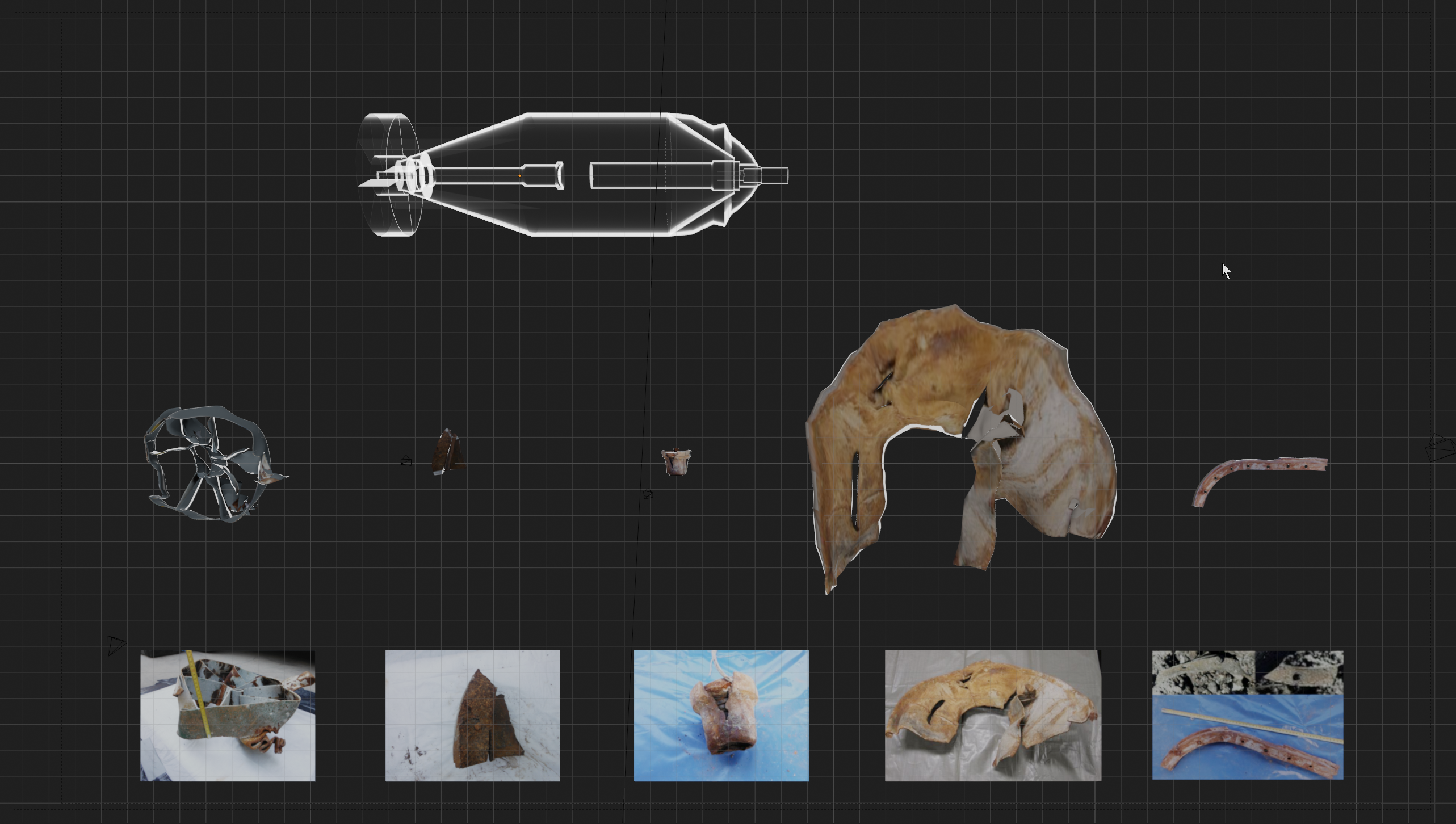
Forensic Architecture reconstructed the M4000 munition used in the chemical attacks at Al-Lataminah, Syria, in March and April 2017. The model matches fragment geometry and projected evidence photographs against technical blueprints. It shows the original shape and origin of a fragmented chemical munition in 3D space.
Background
In the Al-Lataminah chemical attack investigation (Syria, 2017), Forensic Architecture had to prove the origin of a fragmented munition from limited 2D evidence. This case demonstrates situating evidence within 3D space.
How it was likely made
- Modeling the M4000 body (certain): realized using leaked 2D technical blueprints (Russian MoD), hard-surface modeled from reference with the blueprints as a 1:1 "jig."
- Shrapnel modeling (hybrid approach):
- Manual geometry matching: estimating shrapnel geometry manually, light camera matching, then vertex manipulation to match the photo — highly time-consuming.
- Photogrammetry: used intermittently when video walkthroughs of intact munitions became available (late 2019).
- Texture mapping — Project from View: evidence photographs projected onto the 3D geometry.
Animation: shape keys morph shrapnel geometry back to the intact model, animating the transition to demonstrate original fragment positions.
Two likely workflows:
- Model from blueprint → shape parts to match shrapnel (sculpt/vertex manipulation) → animate via shape keys.
- Model from blueprint + photogrammetry of the shrapnel → morph via shape keys → animate. More accurate but more complex.
Open questions
- Which exact scanning techniques were used on the shrapnel?
- Some pieces have details that could not come from a single image; most parts have projected textures.
Summary
This case shows how 2D blueprints, manual fragment matching and intermittent photogrammetry combine into a defensible munition model. Shape-key animation returns damaged fragments to their original positions, which makes the reconstruction readable as evidence.
Resources
- Precision Modeling — the hard-surface workflow used for the body
- Camera Matching — aligning evidence photographs
- Photogrammetry — scanning where footage allowed it
Sources
- Forensic Architecture — Chemical Attacks in Al-Lataminah — the investigation this page reconstructs
- Bellingcat — first images of the bomb type — identification context
- Model archive (GitHub) — downloadable Blender files