Finding an RSF Military Camp — Vehicle Damage & Texture Matching
Provenance
| Source | Organisation & people | Link |
|---|---|---|
| Investigation | Centre for Information Resilience (CIR) | cir.org |
| The film | Centre for Information Resilience (CIR) | youtube.com |
Introduction
Research question: Can we link any cars or people we see in the videos in Libya with the fighting in Sudan?
Object of interest: Vehicle
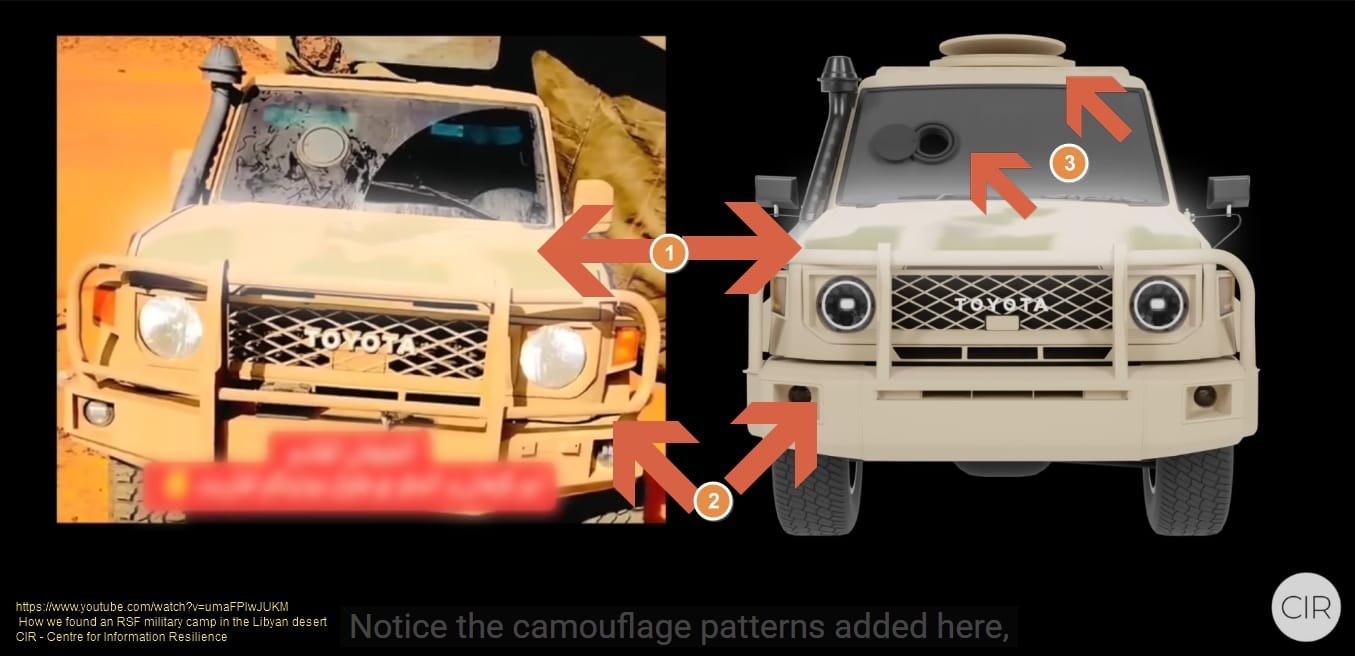
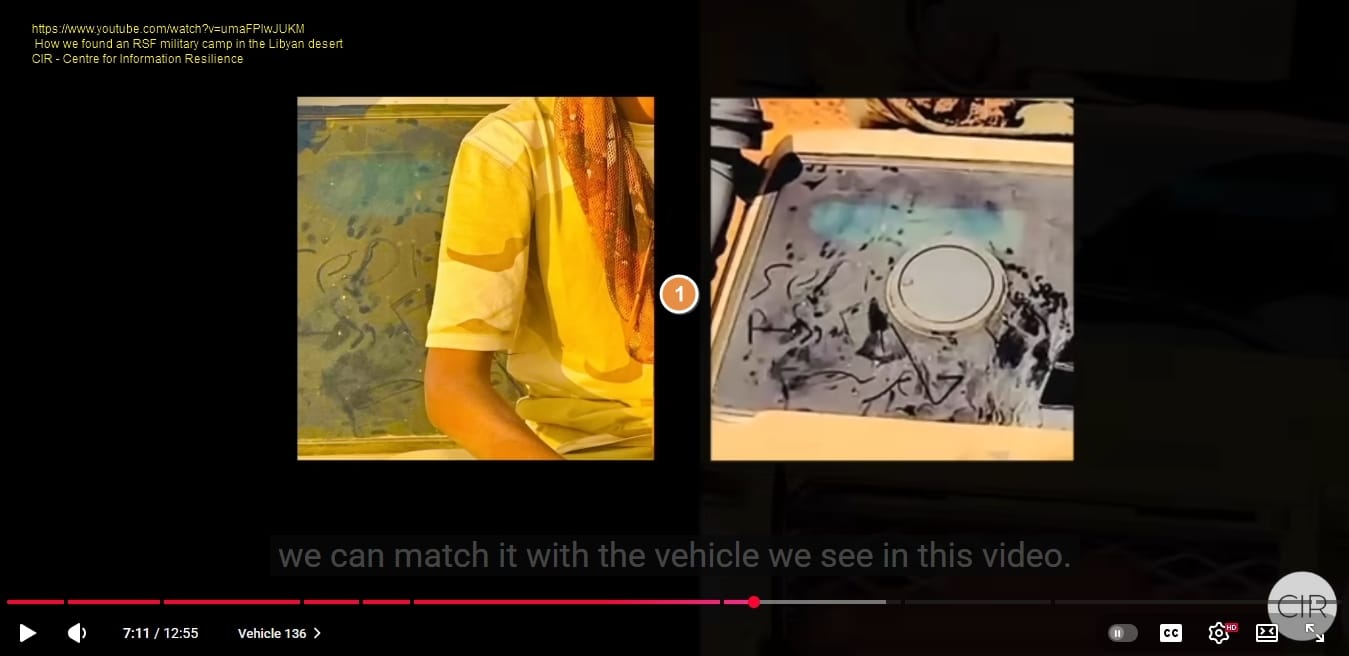
This investigation relies heavily on the car. In such a case you can either model it yourself from reference, or source and adapt it. That's the modeling challenge. The identification process of the car in different places relied primarily on damage, which seems to have been added by texturing (which in turn requires UV unwrapping or a high-density mesh for vertex painting). The hole in the back door might be a texturing job and the structural damage on the door could have been sculpted or manually deformed (for example by using the proportional editing tool).
 Photomatch
 Base Model
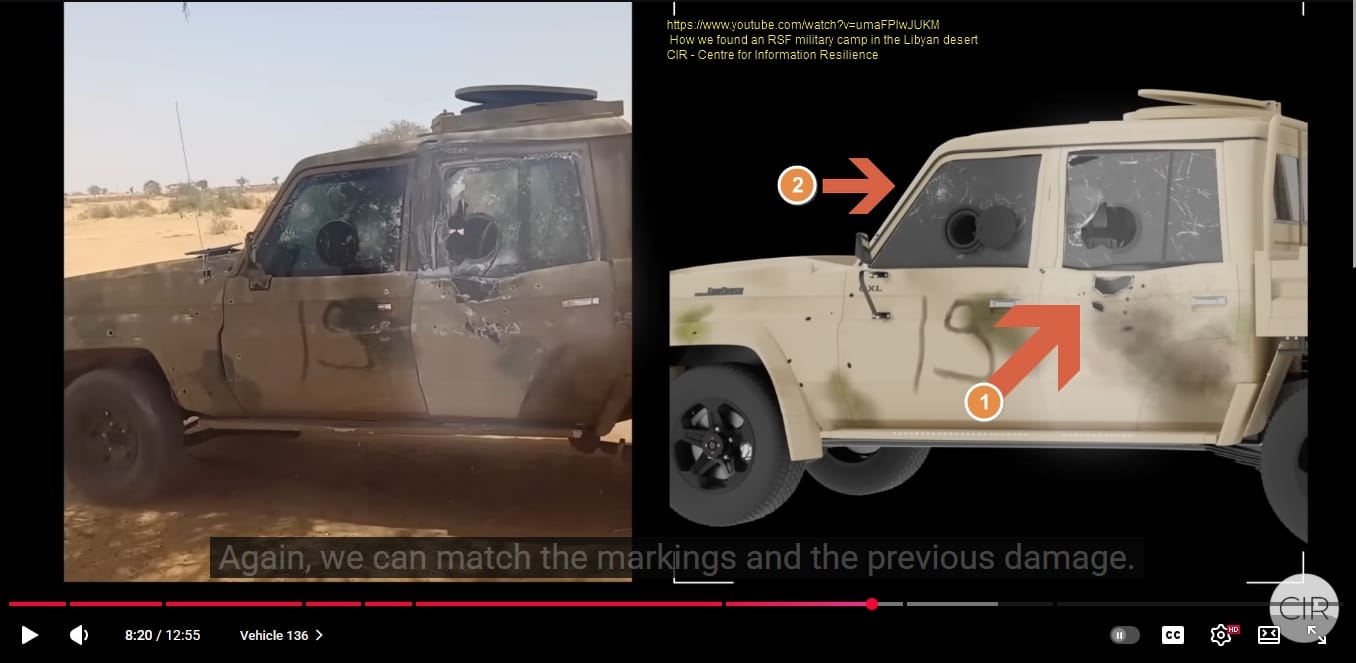 Sculpting or mesh editingThe model also seems to feature damage that goes beyond texturing. The door was likely made into a separate part and its structural damage either sculpted or warped by using the proportional edit tool. Hard to tell whether the hole in the back door is modeled in or textured on top; my first guess would be the latter.Texture Mapping1. Identifying the vehicle type relies heavily on specific textures seen on the original footage, meaning that (parts of) the base model were probably UV unwrapped.Texture Mapping, Sourced Model, Kitbashing1. Another example of the importance of matching textures. 2. Key differences in certain shapes of the model, in this case the bumper rack, suggests that the original model of the car was sourced and the hatch details (3) were modeled by hand and incorporated onto the base modelSculpting or mesh editingThe model also seems to feature damage that goes beyond texturing. The door was likely made into a separate part and its structural damage either sculpted or warped by using the proportional edit tool. Hard to tell whether the hole in the back door is modeled in or textured on top; my first guess would be the latter.Texture Mapping1. Identifying the vehicle type relies heavily on specific textures seen on the original footage, meaning that (parts of) the base model were probably UV unwrapped.
Techniques used (likely)
- Sourced Model: The model is likely sourced. It is very detailed, meaning a SubD/low-poly workflow probably created this base model.
- Custom Details: Military details (the hatches) are added in by hand, likely with a SubD workflow to match the base model's fidelity.
- Texturing & Damage: The answer to the main question relies on matching the car by damage and texture. Texturing requires UV-unwrapping at least parts of the car to paint over them (or projecting/baking the original image onto the model). The model also features non-texture damage: the door was likely separated from the body and its structural damage either sculpted or direct-modeled (e.g., proportional edit).
- Bullet Holes: Modeling bullet holes by hand is very time-consuming — a stencil is faster.
Summary
This case is an example of vehicular identification through damage and texture matching, combining sourced base models, hand-built custom detail, and projected/baked textures.
Resources
- Precision Modeling — the vehicle modeling workflow
- Sculpting — adding structural damage
- Sourcing Models — starting from a base model
- Camera Matching — placing the model against footage
Sources
- Centre for Information Resilience — the organisation behind the investigation
- Finding an RSF Military Camp (CIR) — the film this page follows