GBU-39 Interactive Model
Provenance
| Source | Organisation & people | Link |
|---|---|---|
| Visual guide and interactive model | Open Source Munitions Portal (Airwars and ARES) | osmp.ngo |
| Model author | Azul De Monte | azuldemonte.com |
| Weapon system fact sheet | U.S. Air Force | af.mil |
| Diagnostic remnants report | Armament Research Services (ARES) | armamentresearch.com |
Introduction
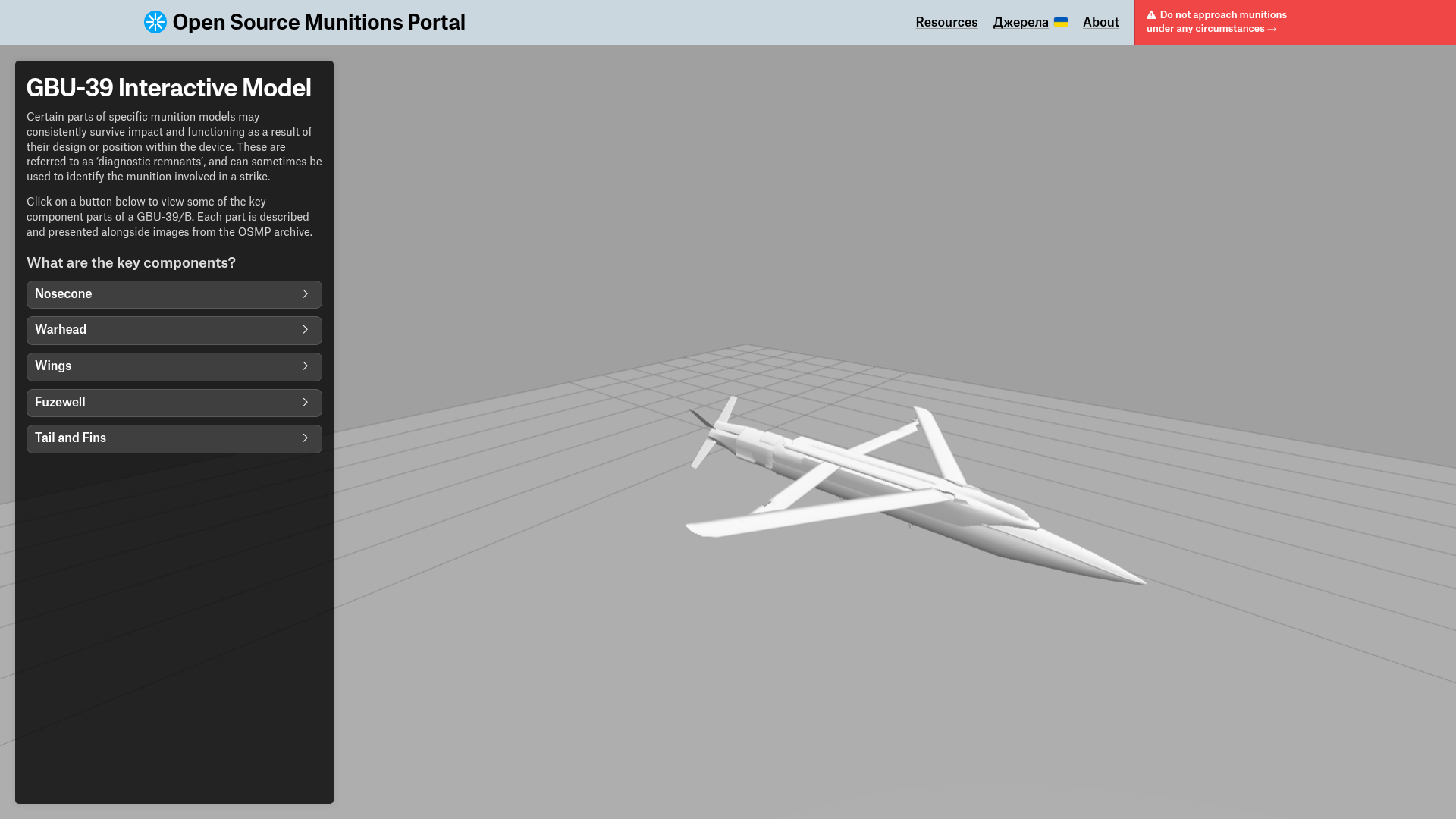
The Open Source Munitions Portal published an interactive 3D model of the GBU-39 Small Diameter Bomb for a general audience. Freelance artist Azul De Monte built the model for Airwars and ARES. The viewer pairs each component with remnant photographs, so readers can identify the munition part by part.
Background
The GBU-39 3D model (GBU-39-v3.glb) was created by freelance 3D artist / visual designer Azul De Monte for the Open Source Munitions Portal (OSMP) project (Airwars and ARES). It serves as a model for the kind of object reconstruction the Bellingcat course aims at.
What the model is
An interactive web application featuring a 3D model of a GBU-39 glide bomb. The user can highlight specific components. The model is evidence-based and forensic: real remnant photos are paired with 3D-highlighted parts for identification and education.
Assets: .glb (low-poly, ~15 distinct parts, ~10,000 faces). Evidence inputs: OSMP photo archives, expert ARES analysis, Boeing/USAF specifications.
How it was likely made
- Hard-surface modeling in Blender from technical references, blueprints, and dimensions.
- Texture projection & camera matching: using footage/photos of real remnants to project textures and ensure accurate representation.
- Mesh hierarchy: parts separated logically (nosecone, folding wings, tail actuation) so each can be highlighted/clicked individually.
- Web optimization: low-to-medium poly count for
<model-viewer>/Three.js,.glb/.gltfexport with proper (possibly baked) materials.
Open questions
- What level of detail is required for the web viewer while maintaining forensic accuracy?
- Translating distinct diagnostic remnants into robust topological representation for investigators.
Summary
This case shows how a forensic 3D asset becomes a web teaching tool: a logical part hierarchy, evidence-based textures and a low-poly export keep the model both clickable and accurate.
Resources
- Precision Modeling — the hard-surface workflow
- Camera Matching — projecting remnant photographs
- Measurements — working from published dimensions
Sources
- OSMP — The GBU-39 air-delivered bomb: a visual guide — the model this page follows
- U.S. Air Force — GBU-39/B fact sheet — specifications
- ARES — Diagnostic Remnants of the GBU-39 — expert identification reference